
Market Snapshot: Canada-Newfoundland and Labrador Offshore Oil Production: Mature Fields and New Frontiers
Connect/Contact Us
Please send comments, questions, or suggestions for Market Snapshot topics to snapshots@cer-rec.gc.ca
Release date: 2026-08-26
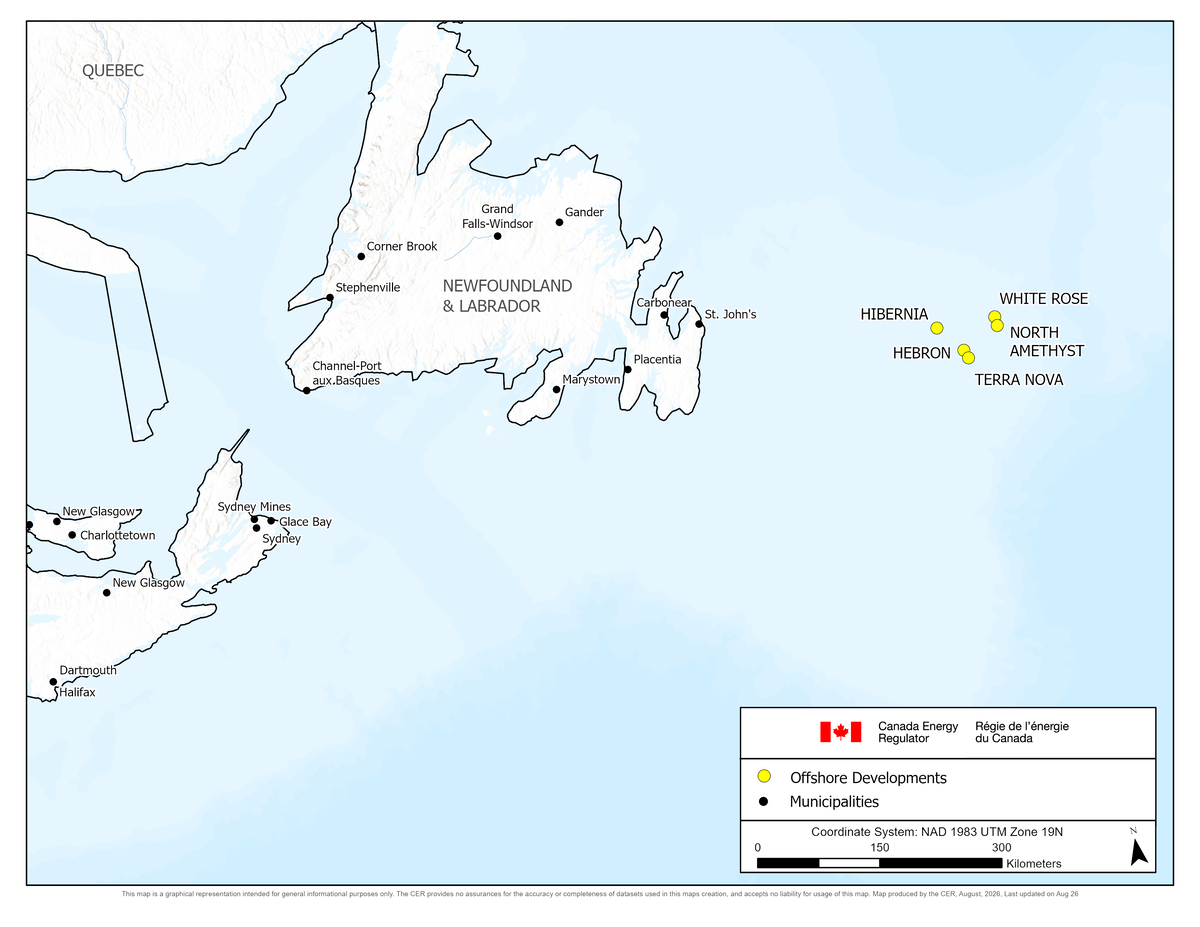
All of Canada’s offshore oil production comes from five fields across four producing projects off Newfoundland and Labrador (NL) (Figure 1). While production was higher in the 2000’s, it has been rising in recent years as investments and Floating Production, Storage and Offloading vessels (FPSOs) refits have extended the life of mature producing fields. Looking ahead, continued production from existing fields, together with the proposed Bay du Nord development, which is being advanced through regulatory and commercial processes, could become significant factors in the long-term outlook for the province’s offshore oil sector.
The Canada-NL offshore area spans about 1.8 million km2, larger than the U.S. Gulf of Mexico. Production began at Hibernia in 1997, followed by Terra Nova (2002), White Rose (2005), North Amethyst (2011) (a satellite field of the White Rose), and Hebron (2017), the province’s first heavy-oil fieldFootnote 1.
Figure 1: Map of currently producing NL offshore oil fields
Source and Text Alternative
Source: CER
Text Alternative: This map illustrates the location of five producing offshore oil fields in NL, from west to east: Hibernia, Hebron, Terra Nova, White Rose, and North Amethyst. It also shows part of Nova Scotia, part of Quebec and NL.
NL accounted for about 4.5% of Canada’s total oil production in 2025, averaging ~240 thousand barrels per day (Mb/d), 15% higher year-over-year.Footnote 2 Production increased further in early 2026 to about 285–310 Mb/d, led mainly by Hebron and Hibernia (Figure 2).
Figure 2: Newfoundland Offshore Oil Production by Field
Source and Text Alternative
Source: Compiled from data provided by the Canada–Newfoundland and Labrador Offshore Energy Regulator
Text Alternative: This graph shows NL offshore oil production by field, in Mb/d, from January 2002 to April 2026. Production remained relatively stable on average from 2002 to mid-2009, then declined until 2015, with some short-term volatility. Production recovered between 2015 and 2020, declined again from 2020 to 2023, and has been rising since 2024.
Offshore Infrastructure and FPSO Refits in NL
Hibernia and Hebron use fixed gravity-based structures (GBS), while Terra Nova and White Rose use FPSOs. As FPSOs age, they require refits to extend both vessel and field life. One refit took Terra Nova offline in January 2020, and the refit of the SeaRose FPSO took White Rose and North Amethyst offline in January 2024. Production resumed at Terra Nova in November 2023 and at White Rose and North Amethyst in March 2025.
Offshore Regulatory Framework in NL
The Canada–Newfoundland and Labrador Offshore Energy Regulator (C-NLOER)Footnote 3 oversees offshore oil and gas activities under the joint federal-provincial Atlantic Accord framework, including safety, environmental protection, and licensing.
Looking Ahead: Offshore Oil Production in NL
Although most producing fields are mature, leading to gradual production declines over time, short-term increases are possible due to FPSO refits. The 2020 Terra Nova refit, for example, extends production to 2033Footnote 4, whereas the 2024 SeaRose refit, together with the West White Rose extension, supports continued production from the White Rose field until 2038.Footnote 5
Beyond existing producing fields, a major project is under development in the Bay du Nord fieldFootnote 6 The field was discovered in 2013 in the Flemish Pass BasinFootnote 7, and the Bay du Nord Project received a positive federal Impact Assessment decision in 2022Footnote 8. On May 5, 2026, Equinor submitted its Development Plan Application to the C-NLOERFootnote 9, advancing the project into the development application review process. The proposed initial phase of the Bay du Nord project, including the Bay du Nord and Cambriol fields, contains estimated recoverable resources 430 million barrelsFootnote 10Footnote 11. The project could become the province's first deepwater oil development and represents a new frontier for NL offshore oil industry, with a 2027 final investment decision and potential first oil by 2031Footnote 12. Its advancement will depend on costs, market conditions, and competitivenessFootnote 13.
NL operates within the global offshore oil marketFootnote 14 and faces competition from major producing areas such as Guyana, Brazil, the U.S. Gulf of Mexico, and NorwayFootnote 15. Investment decisions are influenced by differences in geology, tax and royalty systems, development expenses, and operating conditions, which can lead to variation in project timelines and overall project costs across basinsFootnote 16.
- Date modified: